Physics on the Tabletop
Five quiet demonstrations. Guess first, test second, explain third.
How to use this page
Each demonstration uses things already in a kitchen drawer. Each begins with a question, asks you to write down a prediction, and only then shows the mechanism. The point isn't to get the guess right; it's to notice exactly where your intuition and the world part company.
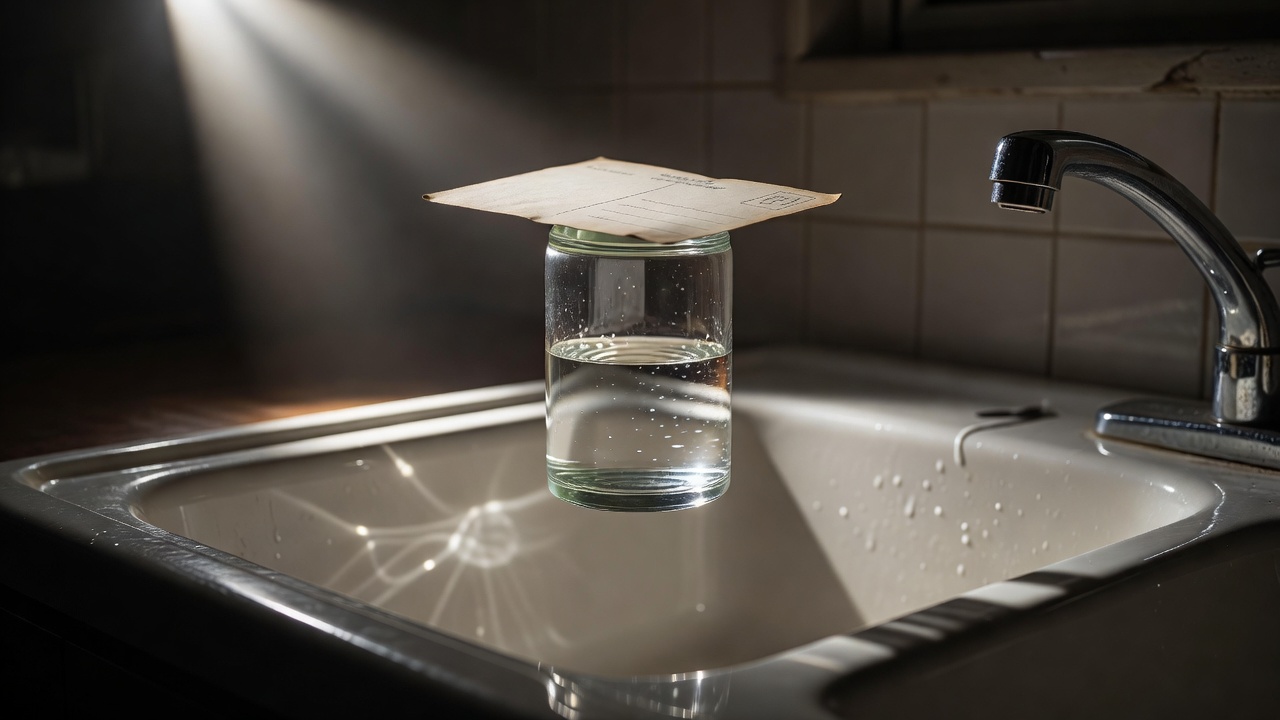
1. The upside-down glass
Why doesn't the water fall?
Air pressure at sea level is about 101 kilopascals, pushing up on the card with far more force than the water's weight pushing down. A thin film of water seals the rim, and surface tension stops air bubbling in. Try it with a half-full glass: the trapped air can expand a little, so it often holds briefly then lets go. That difference is the interesting part.
2. The fleeing pepper
Is the pepper afraid of soap?
No, it is being carried. Water's surface behaves like a stretched skin. Soap lowers the surface tension where it touches, so the stronger tension further out pulls the surface outward, dragging the floating pepper with it. This flow driven by differences in surface tension is called the Marangoni effect.
3. Soap films in a frame
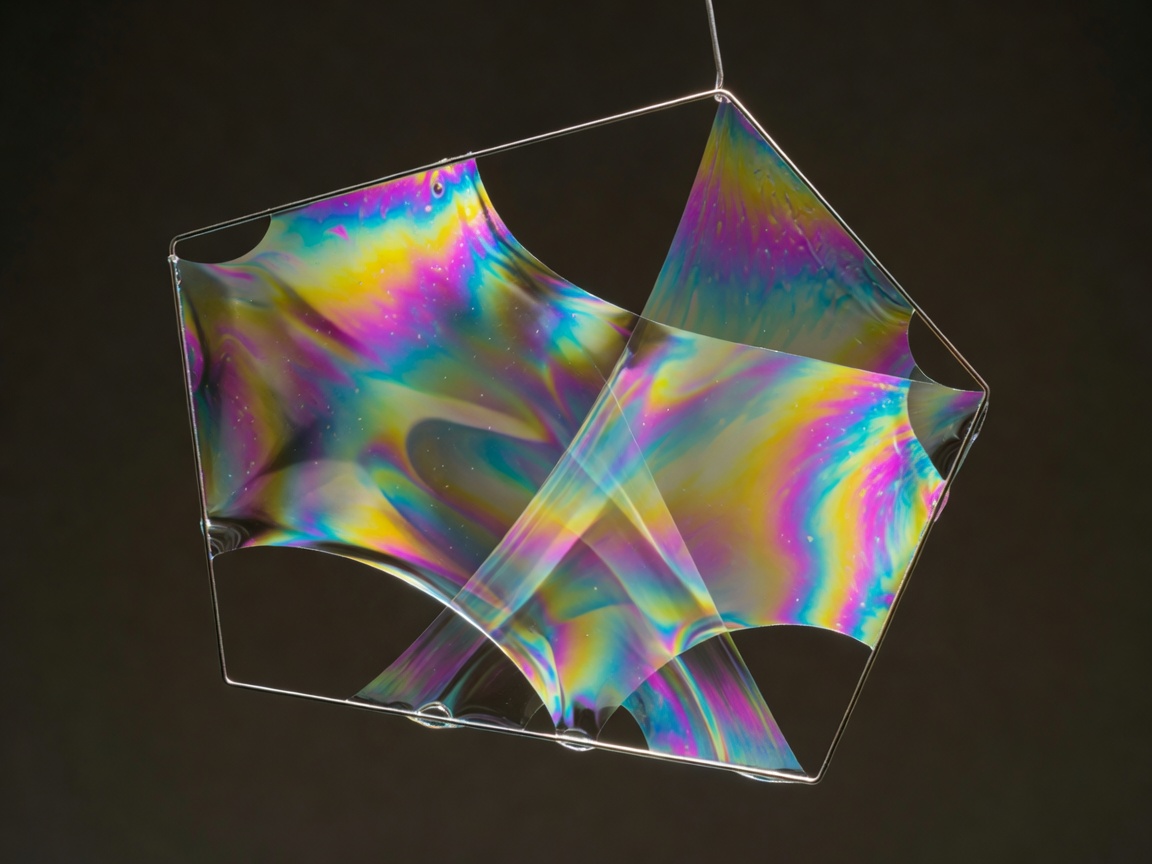
Will the films fill each face of the cube?
No. They pull inward to a shape with the least total area. Belgian physicist Joseph Plateau described the rules in 1873: films always meet three at a time along an edge at angles of 120 degrees, and those edges meet in fours. The film solves a geometry problem faster than you can.
4. Two forks on a rim
Why does it hang in mid-air?
The forks curve back under the rim, so the combined centre of mass of forks and toothpick sits below the point of support. Tip it and gravity brings it back, like a tightrope walker's long drooping pole.
5. A comb that bends water
What pulls the stream sideways?
The charged comb attracts opposite charge in the water stream and repels like charge back towards the tap, so the near side of the stream ends up oppositely charged and is pulled toward the comb. Water molecules are polar, which helps, but induced charge does most of the work. It's a nicer story than "water is magnetic", which it isn't.
For more hands-on wonder, the Exploratorium in San Francisco, founded by physicist Frank Oppenheimer in 1969, publishes many classic demonstrations, and the Science Museum in London and the Deutsches Museum in Munich both keep galleries of working exhibits.