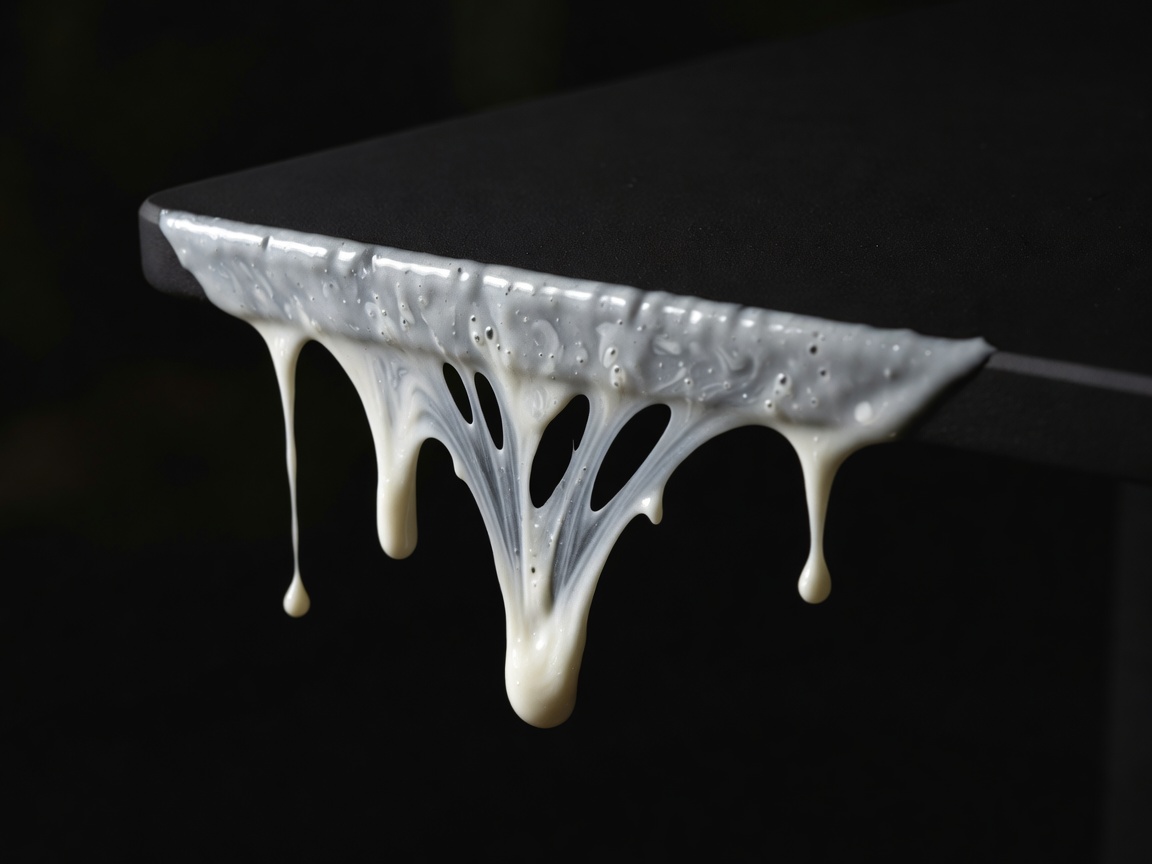
 Materials
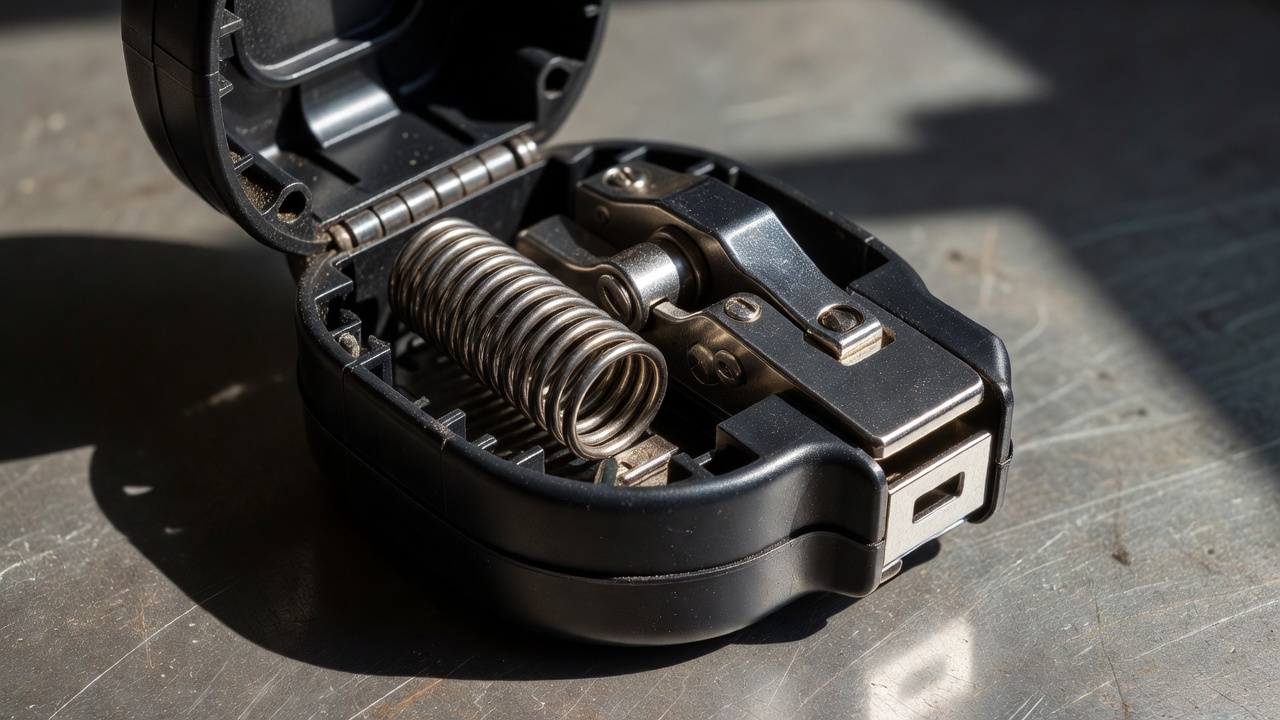
Mechanisms
A Look Beneath the Lever
Cams, pins, springs and floats: the small machines that make ordinary objects feel clever.
The button that counts
Press the top of a retractable pen and the tip appears. Press again and it vanishes. Your thumb moves the same distance, in the same direction, with the same force both times. So how does the pen know which job to do? There is no battery, no switch, no tiny brain. Make a guess before reading on: does the memory live in the spring, the button, or somewhere else entirely?
Where does a click pen store its memory?
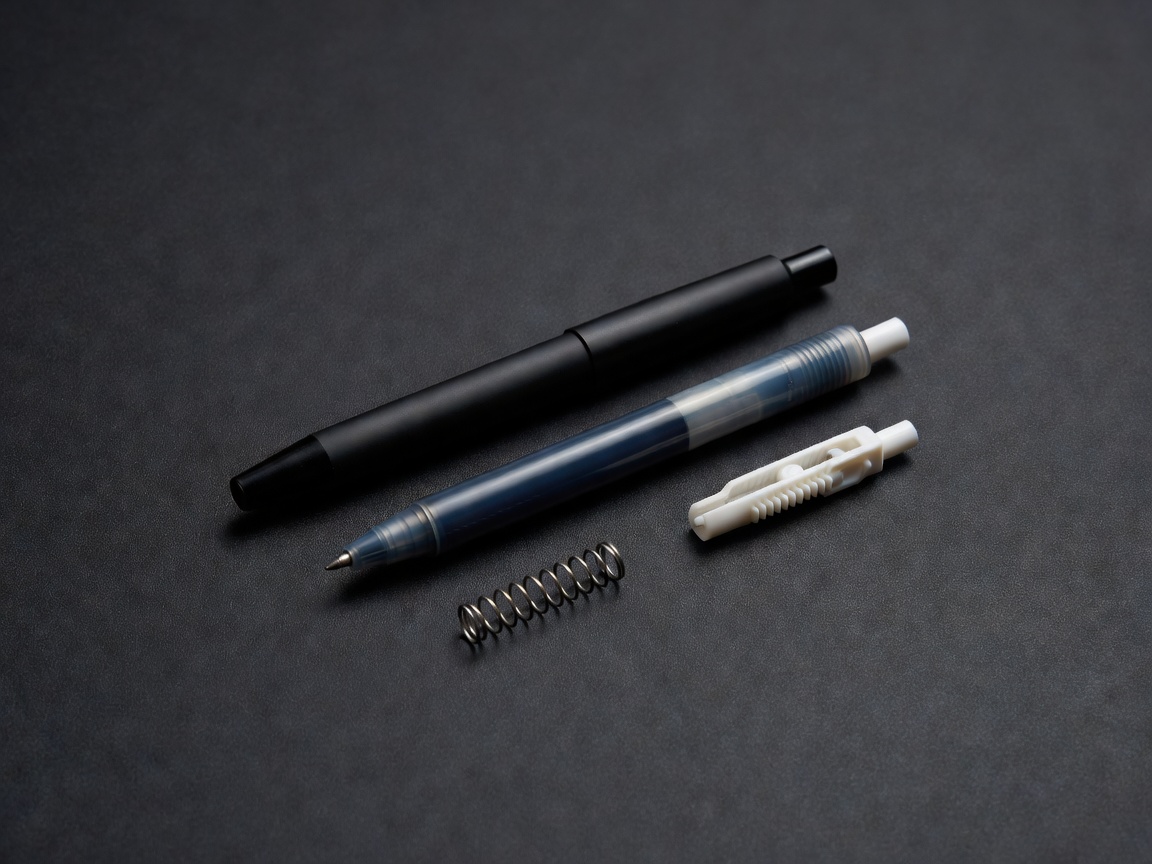
In geometry. A small rotating cam sits between the button and the ink cartridge. Its angled teeth turn it a fraction of a revolution with every press, and alternate grooves inside the barrel are either short (tip held out) or long (tip retracted). The pen remembers by where the cam is pointing.
Rotating cam
The click pen
The design is a close relative of indexing mechanisms used in machine tools and push-push latches on cupboard doors. Here is one full cycle.
- PressThe plunger's saw-toothed end pushes the cam down, compressing the spring around the cartridge.
- TwistOnce the cam clears the ribs in the barrel, the sloped teeth nudge it to rotate part of a step.
- CatchOn release, the spring pushes the cam up onto a short ledge. The tip stays out.
- ReleaseThe next press rotates the cam again, this time into a long channel. The spring sends the cartridge home.
Shear line
The pin tumbler lock
Wooden pin locks were used in ancient Egypt and Mesopotamia, but the compact cylinder version in most front doors owes a great deal to Linus Yale Sr. and his son Linus Yale Jr., who refined and patented pin tumbler designs in the mid-nineteenth century, with the son's cylinder patents arriving in the 1860s.
- RestEach pin stack has a key pin below and a driver pin above, pushed down by a spring. The drivers straddle the gap between the plug and the housing, blocking rotation.
- InsertThe key's cuts raise each stack to a different height.
- AlignWith the right key, every split between key pin and driver pin sits exactly on the shear line.
- TurnNothing crosses the gap any more, so the plug rotates and drives the cam that withdraws the bolt.
A five-pin lock with several possible cut depths offers thousands of combinations, which is why a wrong key feels so emphatic: a single pin a fraction of a millimetre off is enough.
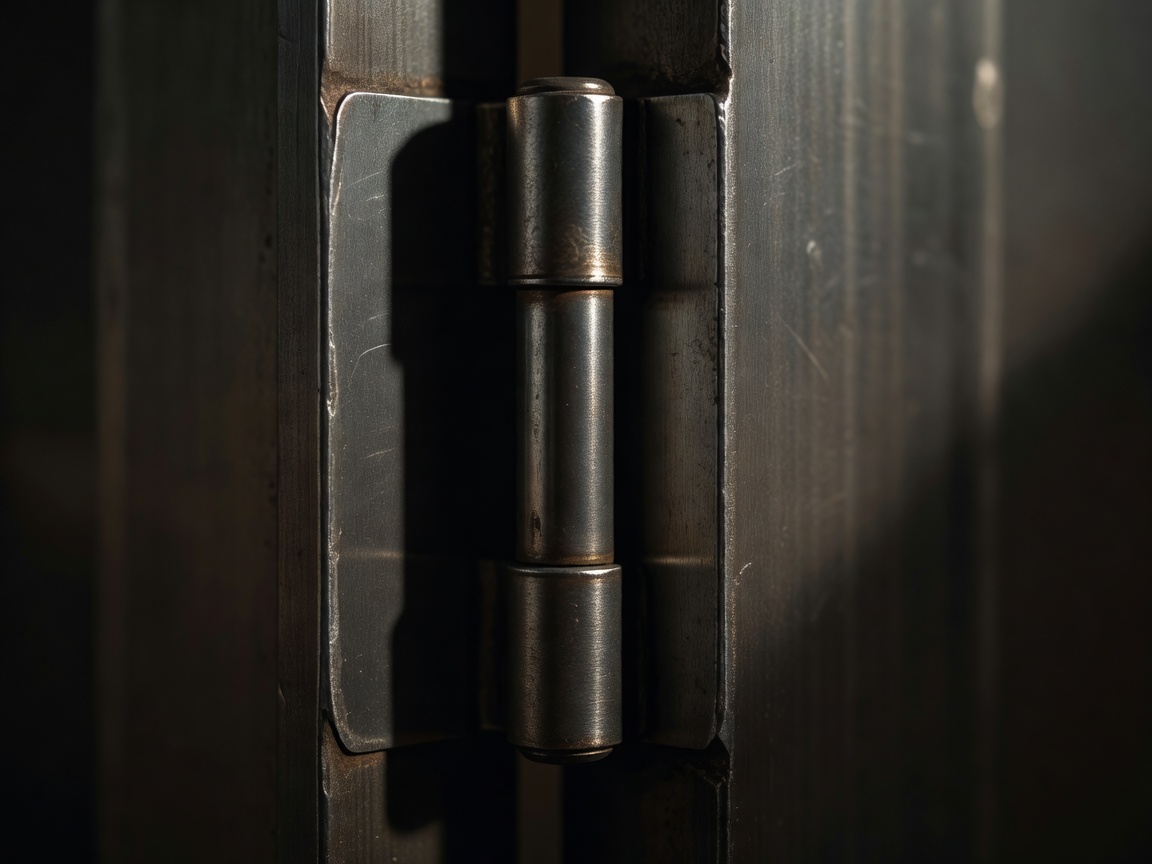
Torque
The hinge and the door closer
Push a door close to its hinge and it feels stubborn. Push near the handle and it swings easily. The door's mass has not changed; your lever has. Turning effect, or torque, is force multiplied by distance from the pivot, so doubling your distance halves the force you need.
Why do heavy fire doors close slowly instead of slamming?
An overhead closer stores energy in a spring as you open the door. On the way back, that spring pushes a piston through oil, and the oil must squeeze through small adjustable valves. The narrow passage sets the speed, much like a syringe resists being emptied quickly.
Feedback
The cistern float valve
A toilet cistern refills and then stops all by itself, which makes it one of the oldest automatic controllers in the house. Ktesibios of Alexandria used a float regulator in a water clock in the third century BC; the principle has not changed much.
- EmptyAfter a flush the float drops, and its arm opens the inlet valve.
- FillWater rises, and buoyancy lifts the float, as Archimedes would have predicted.
- ShutThe arm acts as a lever, multiplying the float's gentle lift into enough force to close the valve against mains pressure.
That is negative feedback: the result of the action switches off the action. Thermostats, cruise control and your own body temperature work the same way.
Ratchet & spring
The tape measure
Three small ideas share one case. A coiled flat steel spring winds up as you pull the blade, then rewinds it. A lever-operated brake pinches the blade to hold it. And the blade itself is curved across its width, a trick that makes thin steel surprisingly stiff, for the same reason a curved sheet of paper can hold out flat while a flat one droops. Then there is the wobbly hook at the end, which looks like poor manufacturing and is in fact precision: it slides by its own thickness so pushing and hooking measurements agree.
Keep looking
Materials Experiments